Months earlier, in a sprawling mansion hidden in the quiet northern district of the city, little Eliza Moore lived a life wrapped in silence and drawn curtains.
She wasn’t forbidden from playing—she was simply told, again and again, that she was “too weak,” “too sensitive,” “too unwell to go outside.”

Her stepmother, Catherine Moore, insisted Eliza needed constant rest. Her father, Thomas Moore, was rarely home, always away on business. And so Eliza spent her days confined to her bed, listening to the world through a window she was barely allowed to open.
One afternoon, a worn leather ball rolled into the garden.
A thin boy chased after it, climbing a tree, hopping over the wall, and landing clumsily on the grass.
Eliza saw him from her window. She didn’t cry out. She waved.
The boy—Noah Reed—froze. Then she smiled. Shy. Gentle. Something sparked in his eyes. From that day on, Noah returned.
They talked through the half-open window, drew pictures with chalk on stone tiles, played card games through the bars, and laughed in a way Eliza hadn’t laughed in years.
Noah became her secret happiness. Her real friend. And the only one who noticed something was wrong.
Eliza wasn’t improving. She was fading—not from illness, but from the care imposed on her.
Catherine and the private physician, Dr. Wallace Crane, kept insisting Eliza needed more rest, more “routine adjustments,” stronger medication. The pills left her dizzy, heavy, barely awake.
Noah was the only one she trusted enough to whisper: “I feel worse every week.”
And Noah did what no adult had done.
He listened.
One evening, after being chased away for “disturbing the patient,” Noah climbed a tree that overlooked the study window.
Inside, Catherine and Dr. Crane sat with wine glasses.
No shouting. No threats. But something deeply wrong.
Catherine complained that Eliza had been “too aware lately.” Dr. Crane assured her the updated treatment plan would keep her “calmer… easier to manage.” He mentioned increasing sedatives. She mentioned inheritance timelines.
They spoke of Eliza as a problem. Not a child. Noah’s heart raced.
He didn’t understand every word, but he understood enough. They weren’t healing her. They were weakening her.
The next morning, Eliza collapsed.
Catherine dismissed it as “another episode.” Dr. Crane administered a heavier dose. By nightfall, Eliza barely responded.
Thomas rushed home in panic, trusting Catherine completely. Noah ran after the ambulance until his legs burned.
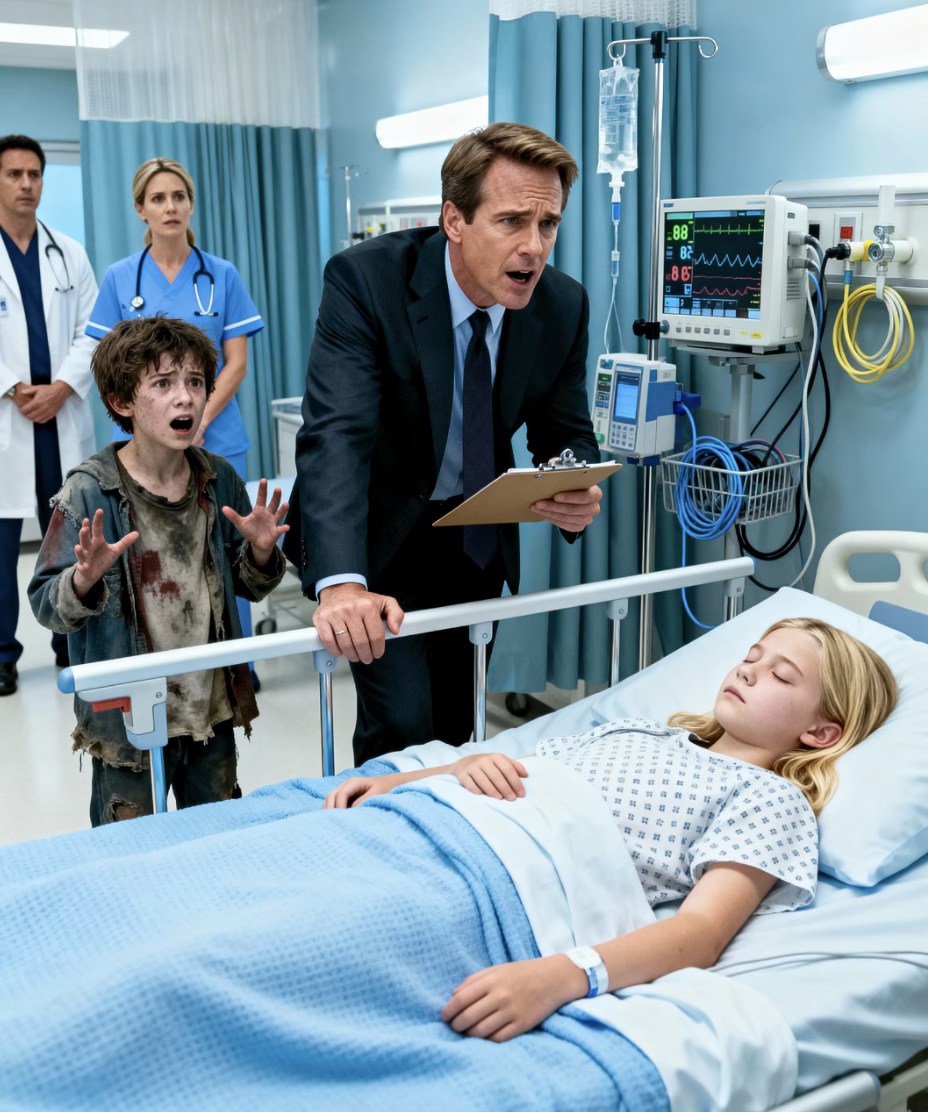
At the hospital, he slipped inside and burst into Eliza’s room, shouting that someone needed to check her medical history, her prescriptions, her files.
Security dragged him out. A nurse told him to stop causing trouble.
As he was pulled away, Noah screamed: “CHECK HER RECORDS! LOOK AT WHAT THEY’RE GIVING HER!”
Something cracked in Thomas’s chest.
How did a boy he had never met know what to question?
Minutes later, Noah broke free and ran back.
This time, Thomas didn’t yell. He didn’t call security.
He said quietly, “Tell me everything.”
And Noah did.
Their friendship. The conversations. What he overheard. What Eliza had whispered through tears. What he believed Catherine and Dr. Crane were doing.
“She wasn’t getting sicker,” Noah said, shaking. “They were keeping her weak.”
Thomas turned toward the adults he had trusted.
Their silence answered him. Their fear confessed everything.
Doctors were called. Records reviewed.
They uncovered serious violations—unauthorized medications, dosages far above recommendations, test results hidden, false reports about Eliza’s condition.
Catherine tried to leave. Security stopped her.
Dr. Crane attempted to interfere with the machines, insisting Eliza “needed them.” A nurse stepped in.
Specialists worked for hours. Sedatives were stopped. Eliza was allowed to wake naturally.
Thomas held her hand. Noah stood beside him.
Then—after what felt like forever—Eliza’s eyes fluttered open.
“Dad…?” she whispered.
Thomas broke down. Noah cried too.
Eliza smiled faintly.
“Noah… you stayed…”
“Always,” he whispered.
Catherine was arrested for medical neglect and fraud. Dr. Crane lost his license and faced prosecution.
Thomas apologized to Eliza for every absence, every moment of blindness.
Then he turned to Noah.
“You saved my daughter,” he said, kneeling. “You saved me too. If you want a home… I would be honored to give you one.”
Noah froze.
“A home?”
“And a family,” Thomas said softly. “If you’ll let me adopt you.”
Noah sobbed. “Yes… I want that.”
Eliza hugged him tightly.
“I have a brother now.”
Months later, Noah started school. It was difficult— years without stability had left gaps—but Eliza defended him fiercely.
“He’s my brother,” she said. “And he’s brave.”
Noah learned. He dreamed again.
At home, there were warm meals, soft blankets, and someone who tucked him in each night.
Every evening, he and Eliza sat in the garden—the same place where a ball had rolled and changed everything.
They laughed beneath a sky that finally belonged to them.
Noah had once had nothing. Eliza had once had everything except freedom.
Together, they saved each other.
In the end, it was the boy no one believed who saw the truth. And the girl who couldn’t stand rose stronger than anyone imagined.
Some bonds begin quietly— through a window, on an ordinary day, with a simple wave. But the strongest ones are the ones that save lives.