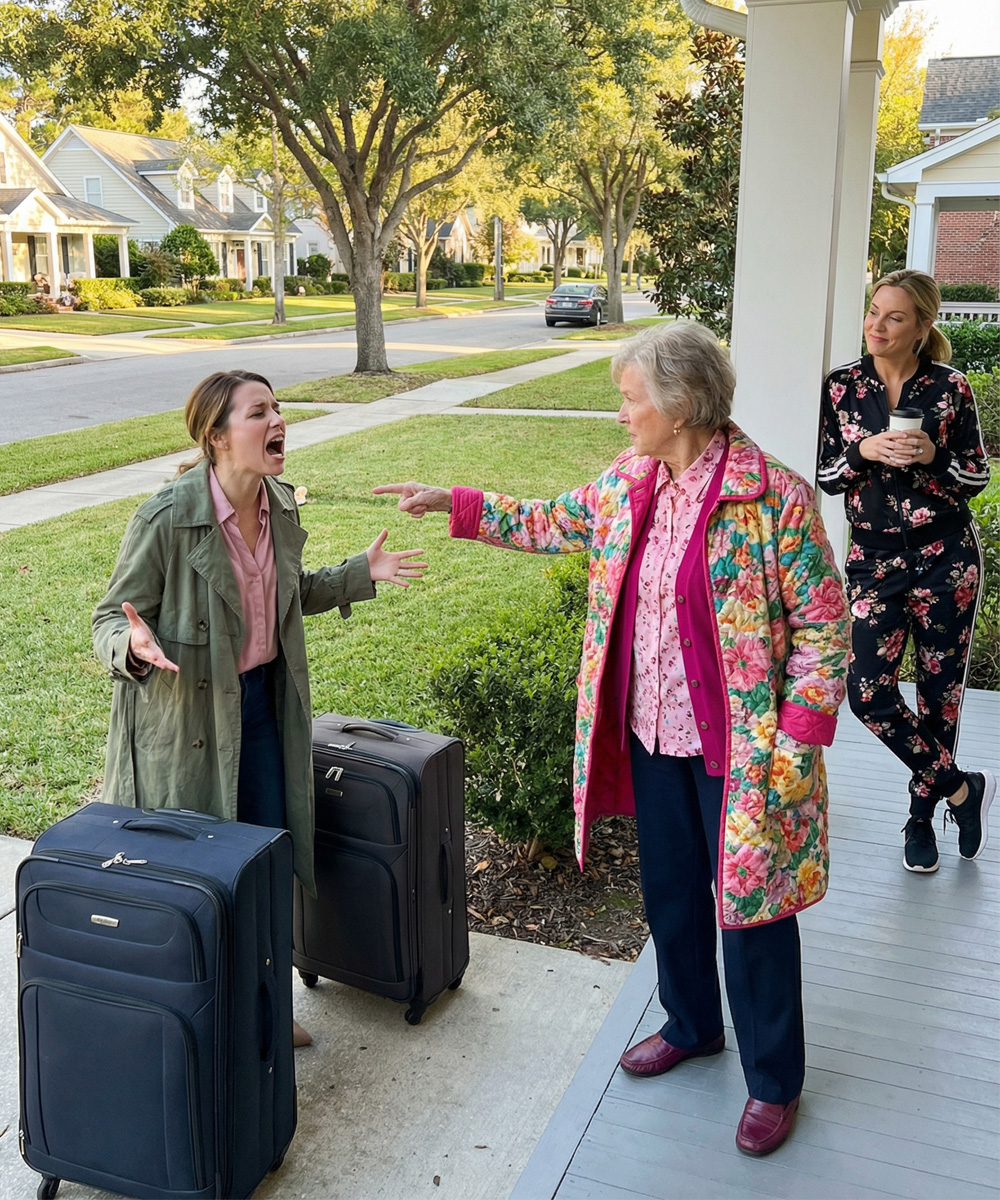
“Emily,” she said, standing in the doorway with her arms crossed, “you have one hour to leave this house. If you’re not gone by then, I’ll throw your luggage on the lawn.”
I blinked, stunned. “What? Why? What did I do?”

Her voice didn’t waver. “My daughter doesn’t like you. And this is her home. Your being here makes her uncomfortable.”
Her daughter—my husband’s stepsister, Heather—stood behind her, smiling smugly as if she’d won something. I’d only been living with them temporarily while my husband, Mark, was away on a month-long work assignment. I was helping with the shopping, cleaning, and even paying the bills. But the moment Heather returned home from her “spiritual retreat,” the atmosphere in the house shifted. She disliked me from the moment she met me, mainly because I had the nerve to build a stable life while she bounced between jobs and drama.
I packed my things quietly. I didn’t cry. I didn’t beg. I didn’t even argue. Something inside me just clicked: a calm decision to walk away and let them deal with the consequences of their cruelty.
I moved into a small Airbnb and kept my head down. I didn’t tell Mark right away; he was already stressed at work, and I didn’t want to distract him until I had everything sorted out.
A week passed. That’s when my phone rang. It was Linda.
“Emily,” she said sharply, skipping any greeting, “why haven’t you paid the rent yet? You know the house payment is due soon.”
I froze. “Rent?” “What are you talking about?” “You live here,” she snapped. “You always help with the mortgage. You owe us this month.”
I couldn’t help it: I let out a short, humorless laugh. “I don’t live there anymore, Linda. You kicked me out.”
Heather’s voice erupted in the background. “She still has to pay! She agreed! She owes us!”
I felt something rising inside me: anger, clarity, and finally, freedom. “No,” I said slowly and firmly. “I don’t owe you anything. Not rent. Not help. Not support. Nothing.”
“You can’t just leave!” Linda yelled. “Oh,” I said, “but I already did.”
The silence on the other end was electric, furious, and deeply satisfying. They needed me more than I needed them, and they were only just now realizing it. Little did I know that the fallout was only just beginning, and that the truth about who they really were was about to explode in a way neither of us expected.
And the moment Mark returned home… everything exploded.
When Mark arrived home two days later, exhausted from his trip, I picked him up at the airport. The second he saw me, his smile vanished. “Um… why do you look like you’ve been through a war?”
I hadn’t planned to unload everything in the arrivals parking lot. But once we were in the car, the words spilled out: what Linda said, how Heather smiled, how I’d been kicked out with barely an hour’s notice.
Mark didn’t interrupt. He didn’t defend them. He didn’t question my version of events. His jaw just tightened, and his knuckles turned white as he gripped his seatbelt.
“You got kicked out of my childhood home,” he said quietly, “and then they asked you for rent?” “Yes.”
He exhaled once: sharp, dangerous. “I’m going to call her.” “Mark, maybe wait…” “No. This ends tonight.”
We pulled into a gas station. He got out, pacing back and forth while dialing. I stayed in the car, but I could hear every word through the open door.
“Mom,” he began, his voice flat and icy, “tell me exactly why you kicked my wife out of the house.”
I heard Linda trying to turn the tables. I heard Heather yelling something in the background. I heard excuses, half-truths, rewrites of the story. Mark didn’t believe a word.
“You had no right,” he said. “None. And then you DEMAND she pay rent after humiliating her? Are you crazy?”
I watched Linda’s manipulation shift to guilt. Then to anger. Then to tears. Mark remained calm.
“If Emily isn’t welcome,” he said, “then neither am I. And you won’t get another penny from us. Ever.”
Heather yelled something unintelligible. Then the call ended abruptly: Linda had hung up. Mark got back in the car, his face somber but resolute. “I’m done,” he said. “We’re going to build our own lives, Em. No more chaos.”
And for a few weeks, things were quiet. Then the messages started. Dozens of them.
From Linda: “Please talk to me.” “You’re destroying this family.” “We need help with the bills.” “You owe us for raising you.”
From Heather: “You ruined everything.” “Mom is suffering because of YOU.” “Do you think you’re better than us?”
I blocked them both. But the real shock came three months later.
One afternoon, Mark got a call from an unfamiliar number. When he answered, his face shifted from confusion… to disbelief… to disgust. “Mom got evicted,” he whispered after hanging up. “Heather drained her savings. Taken everything. Left her with nothing.”
It was ironic. Tragic. Predictable. They tried to use me for stability. Then the one person they stood up for—Heather—financially ruined them.
Mark und ich sprachen stundenlang. Sollten wir helfen? Sollten wir sie kontaktieren? Sollten wir uns zurückziehen? Schließlich einigten wir uns auf etwas Einfaches: Mitgefühl, ohne in den Teufelskreis zurückzufallen. Wir organisierten, dass eine Sozialarbeiterin Linda bei der Suche nach einer vorübergehenden Unterkunft und einem Job unterstützte. Aber wir hielten Abstand.
Und zum ersten Mal seit Jahren fühlte ich mich frei: vollkommen und endlich frei.
Aber Linda hatte noch nicht mit uns abgeschlossen. Denn als sie erfuhr, was wir getan hatten, stand sie weinend vor unserer Tür. Und alles, was ich über sie zu wissen glaubte, zerbrach in einem Augenblick.
Es klopfte an einem Samstagmorgen. Drei langsame, unregelmäßige Klopfzeichen. Mark und ich wechselten einen Blick: dieselbe tiefe Unruhe, die uns beiden durchfuhr. Ich öffnete die Tür, und da stand sie: Linda, dünner als zuvor, ihr Make-up verschmiert und ihre Kleidung zerknittert.
„Emily“, flüsterte sie. „Bitte … darf ich hereinkommen?“
Einen Moment lang erstarrte ich. Nicht aus Angst, sondern aus einem seltsamen, unerwarteten Mitleid, das still in mir aufstieg. Ich trat beiseite.
Sie saß auf dem Sofa, die Hände zitterten im Schoß. Die selbstsichere, gebieterische Frau, die mich einst aus ihrem Haus geworfen hatte, war verschwunden. An ihrer Stelle saß jemand, erschöpft, besiegt … fast klein.
„Ich weiß, ich habe es nicht verdient, hier zu sein“, begann sie. „Aber Heather … hat mir alles genommen.“ Sie sagte, sie würde die Rechnungen bezahlen. Sie sagte, sie würde meine Ersparnisse anlegen. Ich habe ihr vertraut. Ihre Stimme brach. Und sie verschwand.
Mark verschränkte die Arme. „Mama, wir haben dir doch gesagt, dass sie dich manipuliert.“ „Ich weiß“, flüsterte er. „Ich habe nicht zugehört. Ich wollte ihr glauben. Ich wollte … ich wollte jemanden, der mich brauchte.“
Ich ließ es auf mich wirken. Jahrelang hatte ich Heather verwöhnt, sie verteidigt, sie sogar als Waffe gegen mich eingesetzt. Nun trat die Zerbrechlichkeit hinter dieser Bevorzugung endlich zutage.
Linda sah mich an; sie sah mich wirklich an. „Ich habe dich verletzt“, sagte sie. „Ich habe dich bloßgestellt. Ich habe dich wie eine Last behandelt, obwohl du die Einzige warst, die dieser Familie geholfen hat. Ich erwarte keine Vergebung, aber … ich bitte um eine Chance, alles wieder gutzumachen.“
Ihre Entschuldigung hing in der Luft: roh, zittrig, unvollkommen, aber aufrichtig.
Mark setzte sich neben mich. „Mama … wir wollen helfen. Aber nicht mehr wie früher. Kein Geld.“ Kein Einzug mehr. Keine Förderung schlechter Angewohnheiten. Wir helfen dir, selbstständig zu werden, nicht wieder von uns abhängig.
Linda nickte, Tränen rannen ihr über die Wangen. „Ich nehme alles in Kauf, was nötig ist“, flüsterte sie.
In den folgenden Wochen hielten wir unser Versprechen. Wir halfen ihr, ein Zimmer zu mieten, erstellten einen Budgetplan und vermittelten ihr den Kontakt zu einem Gemeindeprogramm, das älteren Menschen half, wieder Stabilität im Leben zu finden. Langsam begann sie, sich ein neues Leben aufzubauen.
Unsere Beziehung heilte nicht auf magische Weise. Es gab Grenzen, klare Grenzen. Aber es gab auch etwas Neues: gegenseitigen Respekt.
Bei meinem letzten Besuch nahm sie sanft meine Hand. „Ich habe dich falsch eingeschätzt“, sagte sie. „Du bist stärker, als ich je gedacht hätte … und du bist gut. Wirklich gut. Danke, dass du mich nicht aufgegeben hast, obwohl ich es nicht verdient hatte.“
Zum ersten Mal habe ich ihr geglaubt.
Manchmal geht es bei Familie nicht um Blutsverwandtschaft oder gemeinsame Geschichte; es geht darum, wer wir werden, nachdem der Schaden angerichtet wurde. Und für mich war die Entscheidung für Frieden statt Rache der Moment, in dem ich endlich das Leben begann, das ich verdiente.
Wenn das Ihre Familie wäre, was hätten SIE getan? Sagen Sie es mir; Ihre Meinung ist mir wichtig.